Most finance agencies running Meta ads into Telegram know the cost-per-link-click and the cost-per-channel-join in aggregate. What they rarely know is which specific ad, in which ad set, for which brand, drove a particular join — and whether that join ever turned into a first-time deposit. That gap is where money quietly leaks out of forex, crypto, iGaming and signals campaigns every month.
Basic Telegram tracking answers “how many people joined?”. Advanced tracking answers the questions that actually move spend: which creative produces the cheapest qualified join, which ad set produces joiners who deposit, and how to feed that signal back to Meta so the algorithm optimises for deposits instead of clicks. Getting that right by hand is brutal — which is why Ott exists. This guide covers what good looks like, and how Ott delivers it across multiple brands in regulated, high-risk verticals.
Why Telegram tracking is harder for finance verticals
A SaaS company tracking trial sign-ups has a clean conversion event on its own domain. Finance agencies don’t. The journey usually looks like: Meta ad → bridge or landing page → Telegram channel or bot → (eventually) a deposit on the broker or exchange platform. The conversion you care about most, the FTD, happens on a system you often don’t directly control, days or weeks after the ad click.
On top of that, regulated verticals carry constraints that break naive tracking setups:
- Account bans and Business Manager churn. Forex and iGaming advertisers routinely run several Business Managers and ad accounts to survive bans. Tracking that only works inside one ad account falls apart the moment you rotate.
- No standard pixel event for “joined Telegram”. Telegram is off-platform. There is no native Meta event firing when someone joins a channel, so the join has to be captured and sent back deliberately.
- Long, indirect funnels. A signals subscriber might lurk for two weeks before depositing. Last-click attribution against the Telegram join alone tells you almost nothing about deposit quality.
Every one of these is a reason to stop hand-building attribution and let a purpose-built tool hold the thread. If you want the full picture of where Telegram tracking sits in the finance stack, our Telegram tracking use-case breakdown walks through the funnel end to end.
What good attribution looks like: fbclid plus the Conversions API
The core of accurate Telegram attribution is the Facebook Click ID (fbclid). When someone clicks a Meta ad, Meta appends an fbclid parameter to the destination URL. That single value is the thread that ties a Telegram join back to the exact ad, ad set and campaign that produced it — the difference between per-ad attribution and a pile of anonymous join counts.
The Conversions API (CAPI) is the other half. Once a join is matched to its originating click, it has to be sent back to Meta server-side, with the fbclid attached, so the optimiser can credit the right ad and start learning who actually joins and deposits rather than who merely clicks. For high-risk advertisers where the browser pixel is unreliable or blocked, that server-side signal is often the only durable one you have.
The catch is that doing this reliably is deceptively fiddly. The fbclid has to be captured at click time and survive a redirect and a Telegram deep link intact; the join has to be matched back to it on the way in; events have to be deduplicated so a single join isn’t double-counted; and match quality has to stay high enough for Meta to accept the signal. Miss any one of those and attribution silently degrades — joins land against the wrong ad, or don’t land at all — which is exactly where hand-built tracking setups quietly break.
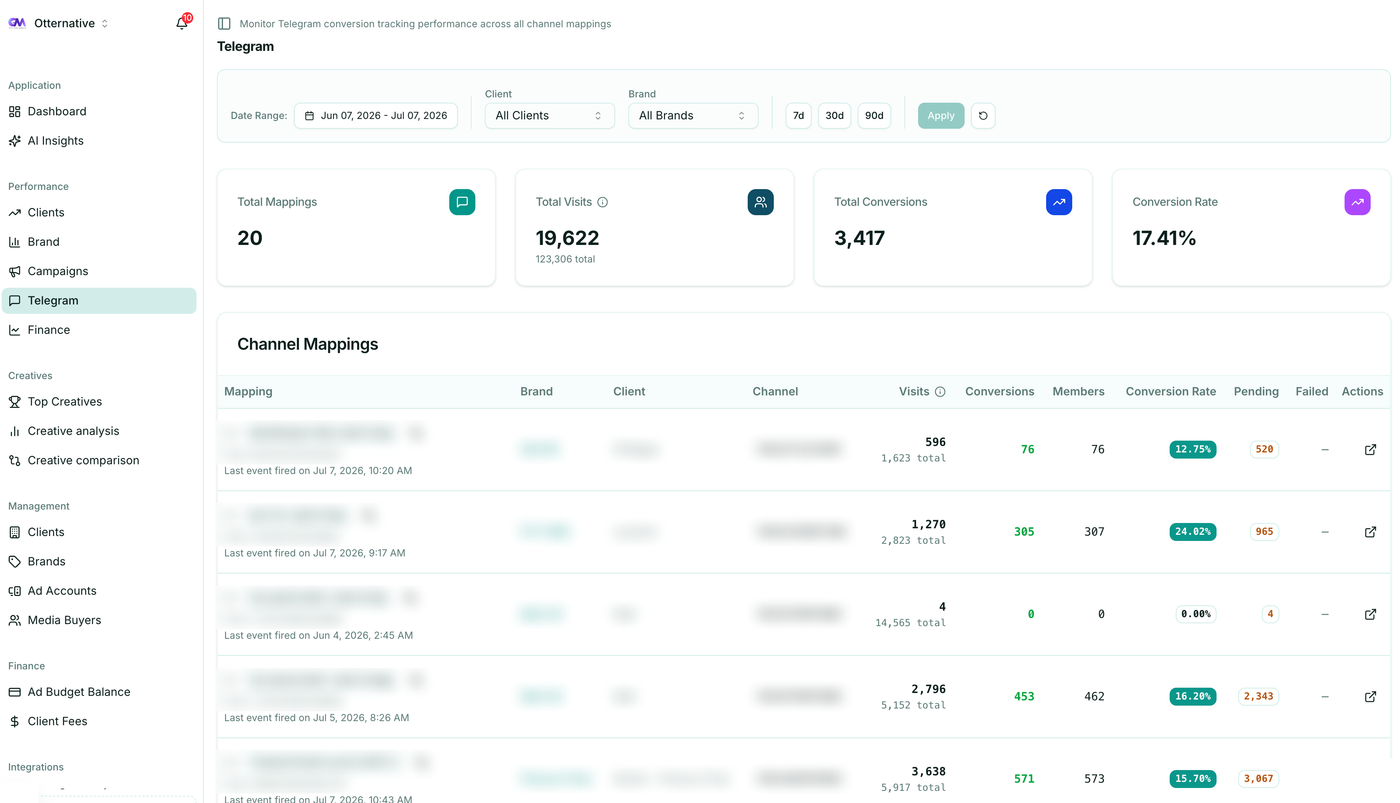
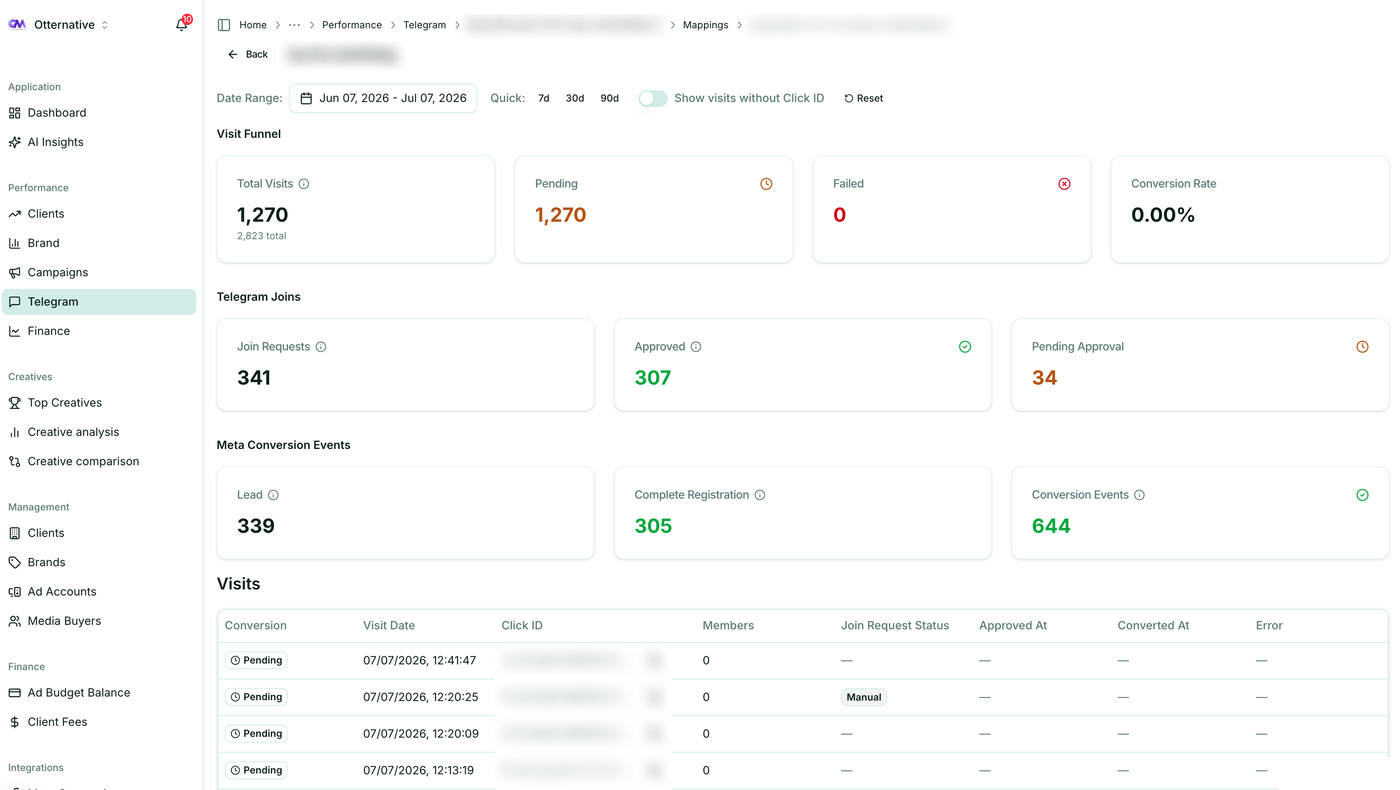
Ott captures the fbclid at click time, matches every Telegram join back to the ad that produced it, and posts it to Meta through CAPI automatically — deduplicated, with match quality maintained, and no manual postback wiring to keep alive. The chain that breaks silently in a DIY setup is the chain Ott monitors for you.
In practice that whole chain collapses into a single view — every Telegram join tied to the ad, brand and client that produced it:
From cost-per-click to cost-per-join to cost-per-FTD
Once joins are attributed per ad, you can build the metric ladder that finance campaigns should actually be judged on:
- Cost-per-Telegram-join — your first real signal of creative efficiency. A creative with a cheap link-click but an expensive join is misleading you.
- Join-to-FTD rate — the share of joiners who become depositors, broken down by ad set. This is where you find the audiences that look cheap but never convert.
- Cost-per-FTD — the number the brand owner cares about. With FTDs logged and tied back through the join to the originating ad, you can rank creatives and audiences by genuine deposit cost.
The point of advanced tracking is to push optimisation decisions down this ladder. An ad set with the cheapest cost-per-join can easily be your most expensive cost-per-FTD if it pulls in tyre-kickers. Ott builds this ladder for you automatically, so every creative and audience is already ranked by genuine deposit cost — no manual join-to-FTD reconciliation. Logging deposits and custom conversions is covered in more depth on our FTD and KPI tracking page.
There’s a practical bonus most trackers can’t offer: Ott lets you download the list of users who joined each channel, per mapping. Hand that list to your sales team and they can reconcile exactly who converted in the broker’s back office — closing the loop between a Meta ad and a funded account even when the deposit happens entirely off-platform.
Multi-brand attribution without losing the thread
A single forex affiliate is straightforward. An agency running five brokers, three casinos and a couple of signals channels is where most tracking setups collapse. The common failure modes:
- One Telegram bot for everything, so joins can’t be cleanly separated by brand.
- Shared landing pages that don’t carry brand or campaign context into the join reference.
- Flat account lists instead of a proper hierarchy, so you can’t roll cost-per-FTD up by client or down to a single ad.
The fix is structural, and it’s baked into how Ott is built. Every join is mapped from ad → reference → Telegram destination per brand, and the reporting layer mirrors how an agency actually operates: Client → Brand → Ad Account. That’s how you answer both “what’s the blended cost-per-FTD for this client?” and “which single ad is dragging down this one brand?” from the same data. Our multi-brand management guide covers how that hierarchy plays out across an agency book.
This is also why generic analytics suites and single-purpose trackers struggle here. A tool that bolts Telegram postbacks onto a flat account list can count joins, but it can’t tell you cost-per-FTD per brand across a dozen clients. If you’re weighing a dedicated tracker against a full platform, the comparison with TGTracker and ClickGram lays out where the single-purpose approach runs out of road.
Handling Business Manager rotation and bans
Because forex and iGaming accounts get banned, your attribution has to survive account changes. Two things matter most, and Ott does both by default:
- Attribution rolls up at the workspace level, not the ad-account level. Joins and FTDs aggregate up to the brand regardless of which Business Manager or ad account produced the click. When you spin up a replacement account, history stays intact.
- The join reference stays independent of the ad account. A reference tied to a specific account ID gets orphaned the moment that account is banned. Ott ties it to the brand and the
fbclidinstead, so a ban never resets your data.
Multi-Business-Manager support is a baseline requirement, not a nice-to-have, for the high-risk and regulated verticals Ott is built for. Forex prop firms in particular tend to rotate aggressively; the forex agencies feature page goes into how the hierarchy and CAPI setup hold together through that churn.
Stop guessing which ad drove the deposit
Advanced Telegram tracking isn’t about more dashboards. It’s about one clean thread — fbclid through the join through the FTD — held intact across multiple brands and surviving the account churn that comes with regulated verticals. Get that right and Meta starts optimising for depositors, your creative decisions get made on cost-per-FTD instead of cost-per-click, and every brand in your book is measured on the same honest metric.
Ott does this out of the box: per-ad Telegram join attribution via fbclid, automatic CAPI postbacks, FTD logging, and a Client → Brand → Ad Account hierarchy, all at a flat monthly fee with no per-Telegram-join charges. Start a free trial or book a demo and see your real cost-per-FTD per brand within a day of connecting Meta.