If you run Meta ads for a forex broker, a crypto exchange, an iGaming brand or a signals channel, your real conversion almost never happens on a web page. It happens inside Telegram, when someone joins a channel or messages a bot. Meta cannot see that event on its own. So unless you wire up attribution deliberately, your campaigns optimise against the wrong signal: link clicks and landing-page views that have nothing to do with whether a paid trader actually showed up.
This is the gap that breaks reporting for finance agencies. You spend in Ads Manager, the join happens off-platform, and the two never get connected. Closing that gap is precisely what Ott does. This piece explains how Telegram conversion attribution actually works for regulated verticals, how the Facebook Click ID ties an ad click to a channel join, and how a platform built for it lets you read the journey from impression to first-time deposit without fooling yourself with last-click maths.
Why the Telegram funnel breaks standard attribution
A normal e-commerce funnel is contained inside the browser. Click, land, add to cart, purchase, pixel fires. Meta sees every step because every step happens on a page Meta can instrument.
The finance-Telegram funnel leaves that environment immediately:
- User sees an ad for a forex signals channel or a crypto airdrop.
- User clicks and lands on a bridge page or goes straight to a Telegram deep link.
- User joins the channel or starts the bot.
- Days later, the user opens an account and makes a first-time deposit (FTD).
Steps three and four are invisible to the Meta pixel. The join is a Telegram event. The FTD lives in your broker’s or operator’s back office. If you only measure what happens before the user leaves the page, you are optimising for the cheapest click, not the cheapest depositor. In high-CPM regulated niches, that mistake is expensive fast.
How fbclid connects the ad to the join
The thread that stitches the journey back together is the Facebook Click ID, or fbclid. When someone clicks a Meta ad, Meta appends an fbclid parameter to the destination URL. That value uniquely identifies the click.
Telegram conversion attribution works by carrying that identifier through the funnel:
- The user clicks your Meta ad. Meta attaches an
fbclidto the landing URL. - Your tracking layer captures the
fbclid(and the campaign, ad set and ad IDs behind it) and binds it to a unique Telegram deep link or start parameter. - The user opens Telegram and joins the channel or starts the bot. The bot records the join against that deep link.
- The join is matched back to the original
fbclidand ad. - The conversion is sent back to Meta through the Conversions API (CAPI) as a server-side event, with the
fbclidso Meta can credit the correct ad.
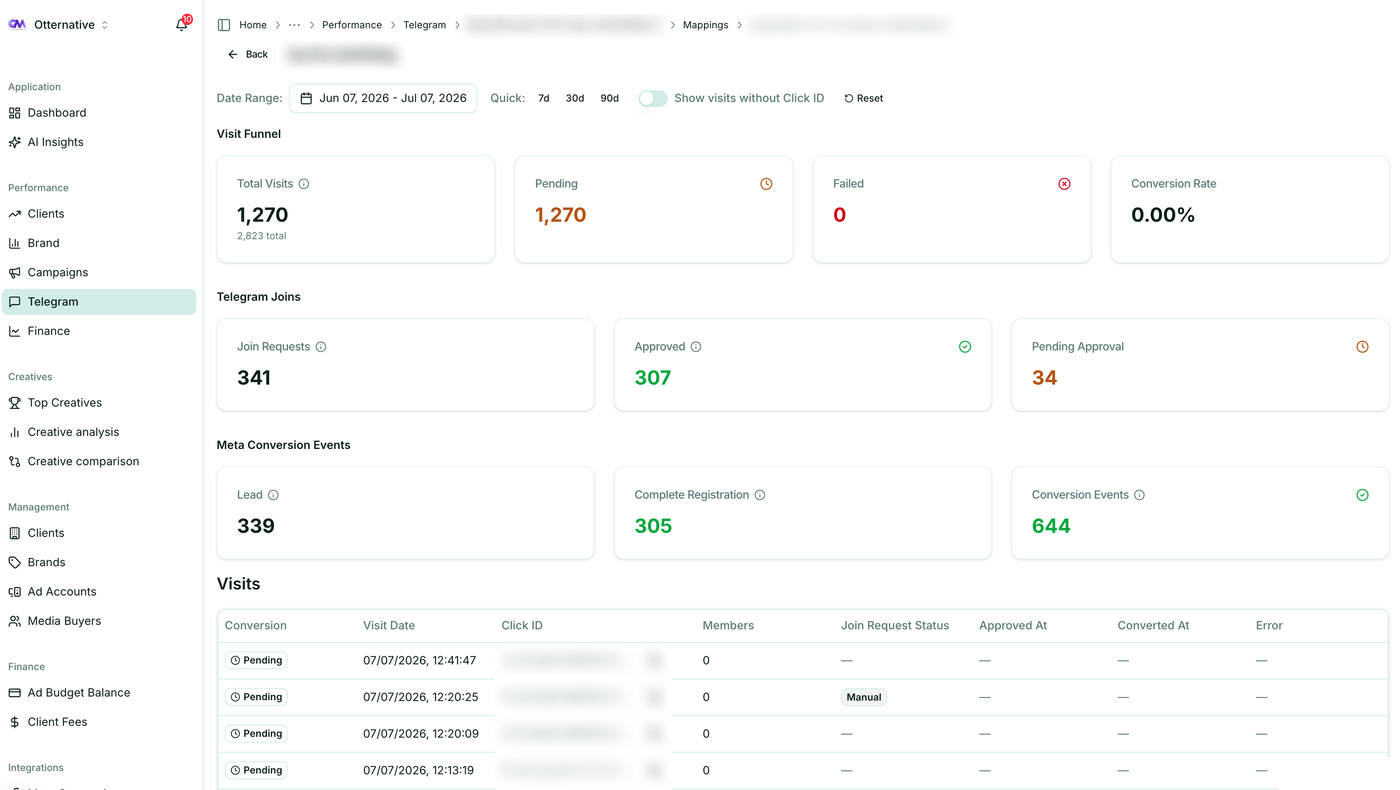
The advantage of a click-ID match over fuzzy modelling is precision. You are not guessing which campaign produced a join based on timing. You are matching a specific click to a specific join. Ott’s Telegram tracking is built on exactly this pattern, which is why it can report a real cost-per-Telegram-join rather than a cost-per-click that may or may not relate to anything.
What the Conversions API does for finance verticals
CAPI is the part most agencies underuse. Sending the join back to Meta as a server-side event does two jobs at once.
First, it closes the reporting loop. The join shows up in Ads Manager as a conversion attributed to the ad that earned it, so your in-platform numbers finally match reality.
Second, and more important for regulated niches, it gives Meta’s optimisation a real signal to chase. When you feed genuine Telegram joins back through CAPI, you can let campaigns optimise toward the conversion that matters instead of toward landing-page views. For a forex agency or an iGaming operator burning through ad accounts, an algorithm tuned to actual depositors-in-waiting is worth far more than one tuned to curious clickers.
This also matters because finance accounts get banned and rebuilt constantly. When you lose an account and spin up a fresh one in a new Business Manager, server-side conversion history feeding the new pixel helps the learning phase recover faster than starting cold on click data alone. Because Ott keeps attribution at the click and join level rather than locked inside one ad account, that history travels with you.
Reading the journey: stages that actually matter
Forget abstract awareness-consideration-decision diagrams. The finance funnel has four concrete checkpoints, and you should be able to put a cost on each:
- Click — someone tapped the ad. Useful only as a denominator.
- Telegram join — the user entered your channel or bot. This is your first real intent signal and your primary optimisation target.
- Qualified engagement — the user stayed, read pinned content, or replied to the bot. Filters out junk joins.
- FTD — the user deposited. The only number that pays the bills.
The single most useful metric this unlocks is cost-per-Telegram-join, and beyond it, cost-per-FTD. Two campaigns can show an identical cost-per-click and wildly different cost-per-join, because one creative attracts tyre-kickers and the other attracts traders. You can only see that difference once joins are attributed per ad. Tracking FTDs as a KPI on top of joins tells you which channels produce depositors versus which just produce members — and in Ott those two numbers sit side by side, per ad and per brand.
Attribution windows for a slow finance funnel
Standard Meta attribution windows were designed for fast e-commerce. The finance journey is slower. Someone might join a signals channel today, lurk for a week, and deposit only after they have seen a few winning calls.
Practical guidance:
- Click-through window: the 7-day click window is a sensible default for the join event itself, since most joins happen within hours or days of the click.
- The join, not the deposit, is the attributed event. Attribute the Telegram join to the ad via
fbclid, then track the FTD as a downstream metric tied to that same user. Do not try to force a 28-day FTD into Meta’s click window; you will mangle both numbers. - Mind the gap between join and deposit. This lag is real and it is where naive last-click reporting falls apart. Measure it explicitly so you know how long to wait before judging a campaign.
If you only ever look at last-click, you will systematically undervalue the prospecting creative that introduced the channel and overvalue the retargeting ad that caught someone already half-decided. For a single-objective join campaign that is tolerable. For a multi-stage funnel across several brands, it quietly misallocates budget.
Where agencies lose the thread
A few failure modes show up again and again in regulated-niche accounts:
- Cross-device drop-off. Someone clicks on mobile, joins on desktop Telegram. A click-ID match carried through the deep link survives this better than cookie-based tracking, which collapses across devices.
- iOS and signal loss. Browser-side pixels lose data to tracking restrictions. Server-side CAPI events are far more resilient, which is the whole point of sending joins from your server rather than the browser.
- Stitched-together tooling. Running a Telegram-only tracker for joins, a separate analytics tool for Meta spend, and spreadsheets to reconcile them means three sources of truth and no single cost-per-FTD. Single-purpose trackers like the ones covered in our Telegram ad tracking tools roundup handle the join but leave you to assemble the rest by hand.
The fix is to keep the click ID, the join, the CAPI postback, the Client → Brand → Ad Account hierarchy and the FTD in one system, so attribution is a query rather than a reconciliation project. That single system is Ott.
Make the journey one connected picture
Telegram conversion attribution is not really about choosing an attribution model. It is about not losing the thread when the user steps off the web page and into a chat app. Capture the fbclid at the click, carry it through the deep link to the join, send that join back to Meta through CAPI, and tie the eventual FTD to the same user. Do that, and the question stops being “which model do I trust” and becomes “what does a depositor from this campaign actually cost”.
Ott does this end to end for forex, crypto, iGaming and signals agencies: per-ad Telegram joins, CAPI postbacks, FTD tracking and the full Client to Brand to Ad Account hierarchy, at a flat monthly fee with no per-join charges. Start a free trial and connect your funnel, or book a call if you want to see how it maps to your verticals first.