If you run Meta ads that send people into Telegram channels, you already know the problem: Meta optimises for clicks and landing-page views, but your real conversion — the Telegram join — happens off-platform where the pixel can’t see it. Generic PPC reporting tools like Supermetrics and AgencyAnalytics won’t help here. They report CTR and CPM; they have no idea who joined your channel.
This guide compares the tools that actually close that loop — attributing Telegram joins back to the exact ad, campaign, and creative that drove them, usually via the Facebook Click ID (fbclid) and Meta’s Conversions API (CAPI).
What to look for in a Telegram tracking tool
- Per-ad attribution — joins mapped to the specific ad/creative, not just a campaign total.
- Meta CAPI postback — joins sent back to Meta so the algorithm can optimise for community growth.
- Finance-vertical fit — FTD (first-time deposit) and revenue tracking for forex, crypto, and iGaming.
- Multi-client structure — agencies need a Client → Brand → Account hierarchy, not a flat list.
- Predictable pricing — flat fees, with no wallet to top up, beat per-user or volume-tier billing as you scale.
| Ott | TGTracker | ClickGram | Optivyro | AdTarget | TracerGram | |
|---|---|---|---|---|---|---|
| Per-ad Telegram attribution | ✓ | ✓ | ✗ | ✗ | ✗ | ✓ |
| Meta CAPI postback | ✓ | ✓ | ✓ | ✓ | ✓ | ✓ |
| FTD / deposit tracking | ✓ | ✓ | ✗ | ✓ | Coming soon | ✓ |
| Client → Brand hierarchy | ✓ | Sub-accounts | ✗ | ✗ | ✗ | Workspaces |
| Full Meta campaign analytics | ✓ | ✗ | ✗ | ✗ | ✗ | ✓ |
| Budget monitoring | ✓ | ✗ | ✗ | ✗ | ✗ | ✗ |
| Flat monthly pricing | ✓ | ✗ | ✓ | ✓ | ✓ | ✓ |
| No prepaid wallet to babysit | ✓ | ✗ | ✓ | ✓ | ✓ | ✓ |
A €2 cost-per-join looks great until you put cost-per-FTD next to it. One channel can flood you with cheap joins that never deposit, while a “pricier” channel brings in members who fund accounts on day one. If your tool reports joins but not the deposit behind them, you’re optimising toward the wrong number and quietly starving your best-earning campaigns.
The tools, ranked
Ott — best overall for finance agencies
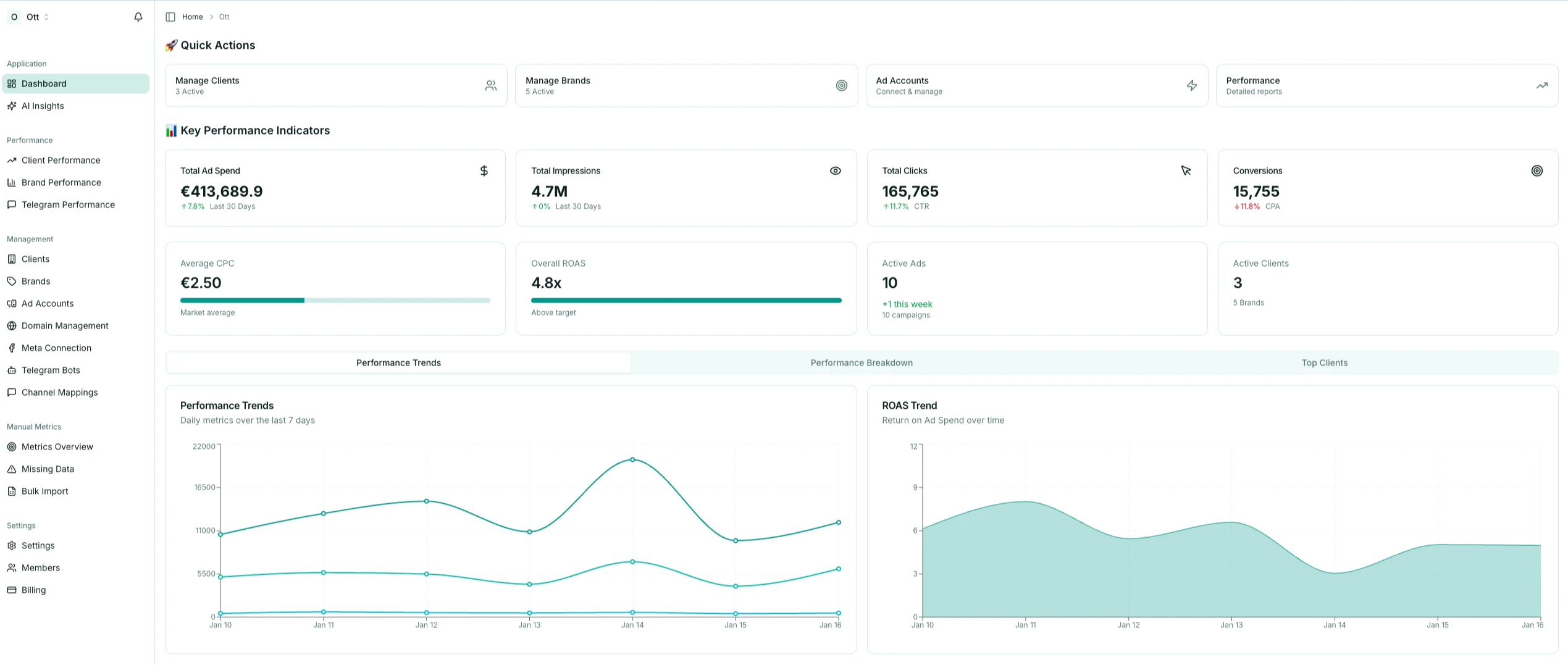
Top pickOtt is the only tool here that is a full agency platform, not just a tracker. It attributes Telegram joins per ad via the Facebook Click ID, sends them back to Meta through CAPI, and sits on top of complete Meta campaign analytics, a Client → Brand → Account hierarchy, budget monitoring, and FTD logging — the metrics finance clients actually pay you to deliver.
Most tools below close only one piece of this loop, so you end up stitching a tracker onto a reporting tool onto a spreadsheet. Ott collapses all of it: spend, cost per joinee, and cost per deposit live in one dashboard, per client, at a price that doesn’t move when your ad spend does.
TGTracker — a Telegram platform billed per tracked user
TGTracker has grown well beyond a join postback. It attributes joins, bot starts and DMs to the ad that drove them, sends postbacks to Meta, TikTok and Google Ads, tracks FTDs as a metric, and offers a bot builder, a CRM inbox and white-label sub-accounts for agencies. It bills $0.03–0.09 per tracked user from a prepaid in-app wallet, so the bill grows with your audience and someone has to keep the balance topped up. What it doesn’t cover is the Meta side: no campaign analytics, no Client → Brand → Ad Account hierarchy, no ad budget balances. Ott pairs the same join attribution with that Meta layer, for a flat fee with nothing to top up.

ClickGram — affiliate S2S, not agency reporting
ClickGram is built for affiliate S2S workflows and handles postbacks competently for that crowd. For a finance agency it’s the wrong shape: €59–1,199/mo for a single-purpose tracker with no Meta campaign analytics, no Client → Brand hierarchy, and no FTD ledger — so you still can’t tell a client which creative funded the most deposits. Ott gives you that full chain, structured per client, in one platform.

Optivyro — CAPI-first, but blind after the postback
Optivyro does the hard part of Meta Conversions API integration well for high-risk verticals: it tracks Telegram joins and DMs and sends deposit and FTD events, for a flat €250/month. What it doesn’t offer is everything around it: no budget ledger, no multi-client structure, no client reporting. Ott sends the same CAPI signal, then shows you the ad, the join, the deposit, and the client P&L on top of it.
AdTarget — a low-cost multi-channel CAPI tracker
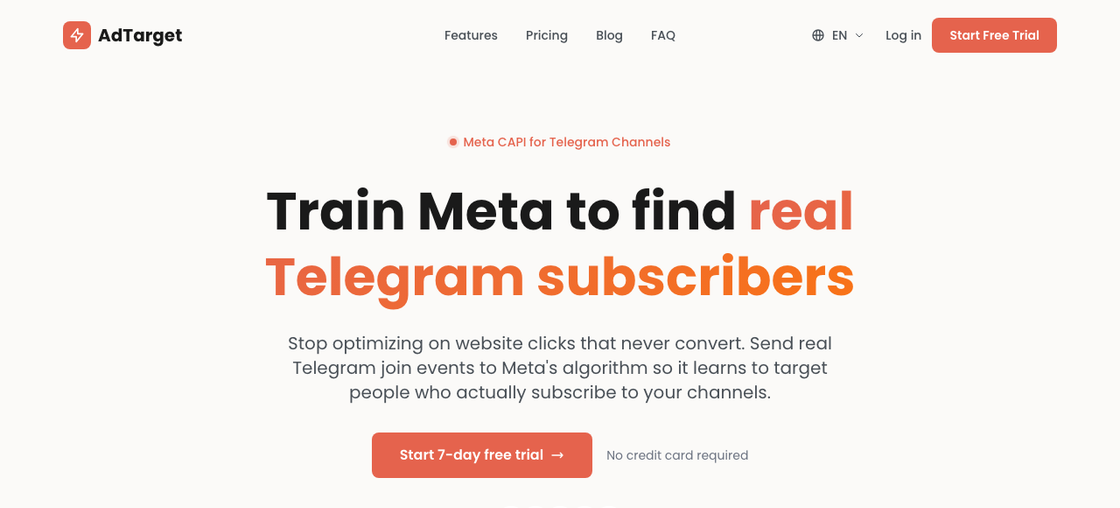
AdTarget covers CAPI across Meta, TikTok, and Snap from $29/month (500 events on Starter), which is useful if you truly buy on all three. It remains a tracker: FTD tracking is listed as coming soon, and there is no agency hierarchy and no budget monitoring. Ott tracks joins and deposits at a flat rate and wraps them in the campaign and client reporting AdTarget doesn’t offer.
TracerGram — a full Telegram funnel tracker at a flat fee
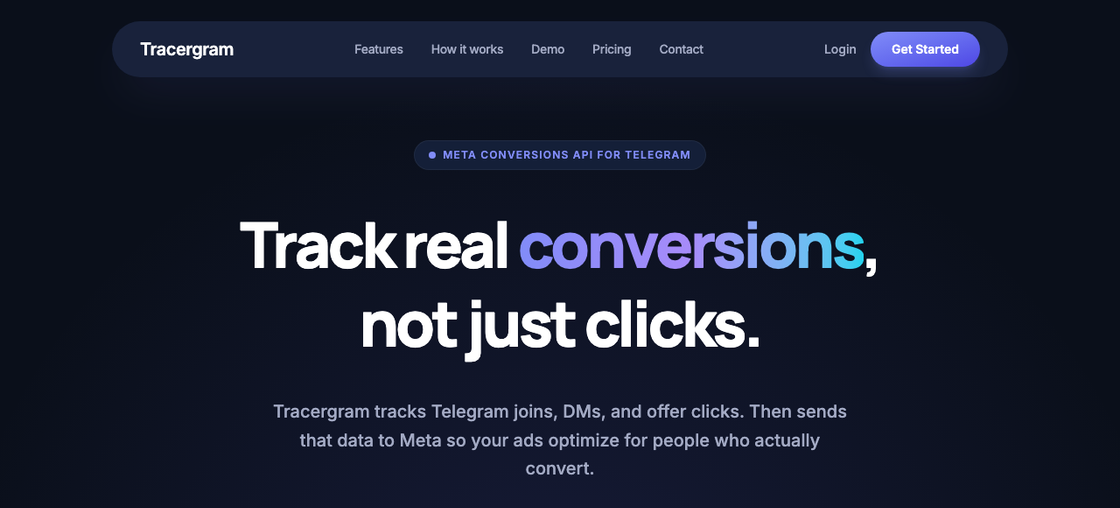
TracerGram tracks Telegram joins, DMs and offer clicks across multiple Telegram destinations and workspaces, attributes FTDs and repeat deposits to the campaign that brought the visitor in, and sends conversions back to Meta through the Conversions API — as well as to TikTok, Snapchat, OpenAI Ads and Whop. It shows Meta campaigns, ad sets and ads beside Telegram outcomes, and team members get their own logins scoped to specific workspaces and ad accounts. Pricing is a single flat plan with unlimited events.
Where it differs from Ott is the agency layer: it is built around workspaces rather than a Client → Brand → Account hierarchy, and it doesn’t advertise prepaid budget or fee monitoring. If your work is the Telegram funnel itself, TracerGram covers it well; if you also run client budgets and reporting across many brands, that is the part Ott adds.
What about Supermetrics, AgencyAnalytics, and the rest?
General PPC reporting tools simply don’t track Telegram. They connect to Meta’s API and report standard ad metrics — useful, but blind to what happens after the click. If your conversion event lives inside a Telegram channel, a reporting connector can’t answer the one question your client is paying you to answer: which ad drove the joins that deposited? Ott starts where those tools stop — it reads Meta’s API for the full campaign picture and closes the Telegram loop underneath it.
The verdict
Most alternatives here focus on the Telegram side of the funnel: a Telegram platform with bots and agency sub-accounts (TGTracker), an affiliate S2S layer (ClickGram), or a CAPI pipe (Optivyro, AdTarget). TracerGram covers the Telegram funnel end to end, from join to deposit to CAPI. None of them advertises a Client → Brand → Ad Account hierarchy or budget monitoring, so once you manage several finance clients, that part still lives in spreadsheets.
Ott tracks Telegram joins per ad, posts them back to Meta, and ties each one to its deposit and gives you the full Meta campaign analytics, Client → Brand → Account hierarchy, budget monitoring, and FTD reporting an agency actually runs on — at a flat price that never grows with your ad spend. That’s not a tracker with extras; it’s the platform the trackers are a feature of.
Any tool priced per tracked user (TGTracker) or by subscriber volume (ClickGram) gets more expensive precisely when a campaign works. Scale a winning client and the extra joins push your tracker bill up with them — you’re taxed for doing your job well. Flat pricing turns tracking into a fixed cost you can build into a client’s retainer, so every extra euro of managed spend lands in your margin, not your vendor’s.
Start a free trial or book a demo to see Telegram attribution in your own funnel.